

Replacing Marketing Guesswork With Systems
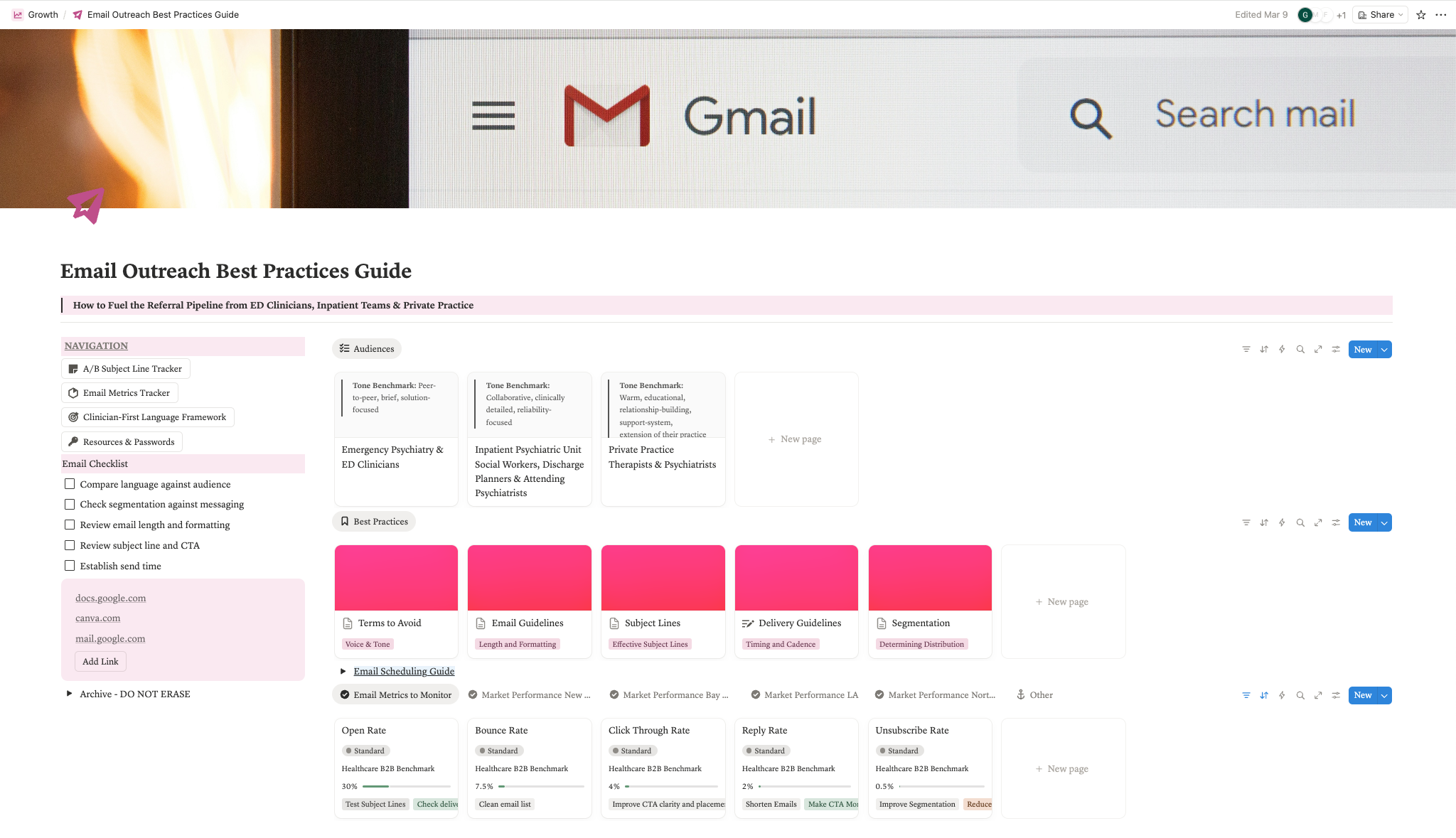
Built an email operations framework covering subject lines, delivery timing, A/B testing, benchmarks, and reporting across four markets — creating a repeatable system for testing and optimization.
The team was moving fast — building campaigns, sending outreach, launching in new markets — but nobody was tracking what was actually working. Emails were going out without benchmarks, without A/B testing, and without a system for measuring outcomes against goals.
As a marketing team of one, I needed a way to not only implement best practices myself, but to create shared awareness across the team. Every change or recommendation I made needed to be grounded in data — not opinion — so the system had to both track performance and educate the team on why specific decisions were being made.
I researched industry benchmarks, documented operational standards, and built a living Notion workspace that the growth team could reference and contribute to.
Open rates by market (week of Feb 23, 2026)
Best practices hub
Living Notion workspace with modular courses — subject lines, formatting, delivery timing, clinician-first language — plus a pre-send checklist and scheduling calendar.
Performance tracker
Per-market open rate dashboards with benchmark status, A/B test logging, and conditional playbooks for when metrics fall below target.
This system replaced gut-feel decision-making with a data-backed feedback loop. Every campaign now has benchmarks, every subject line gets tested, and every recommendation is justified by performance data — giving a marketing team of one the credibility and clarity to drive change across the organization.